
Last updated November 2, 2026
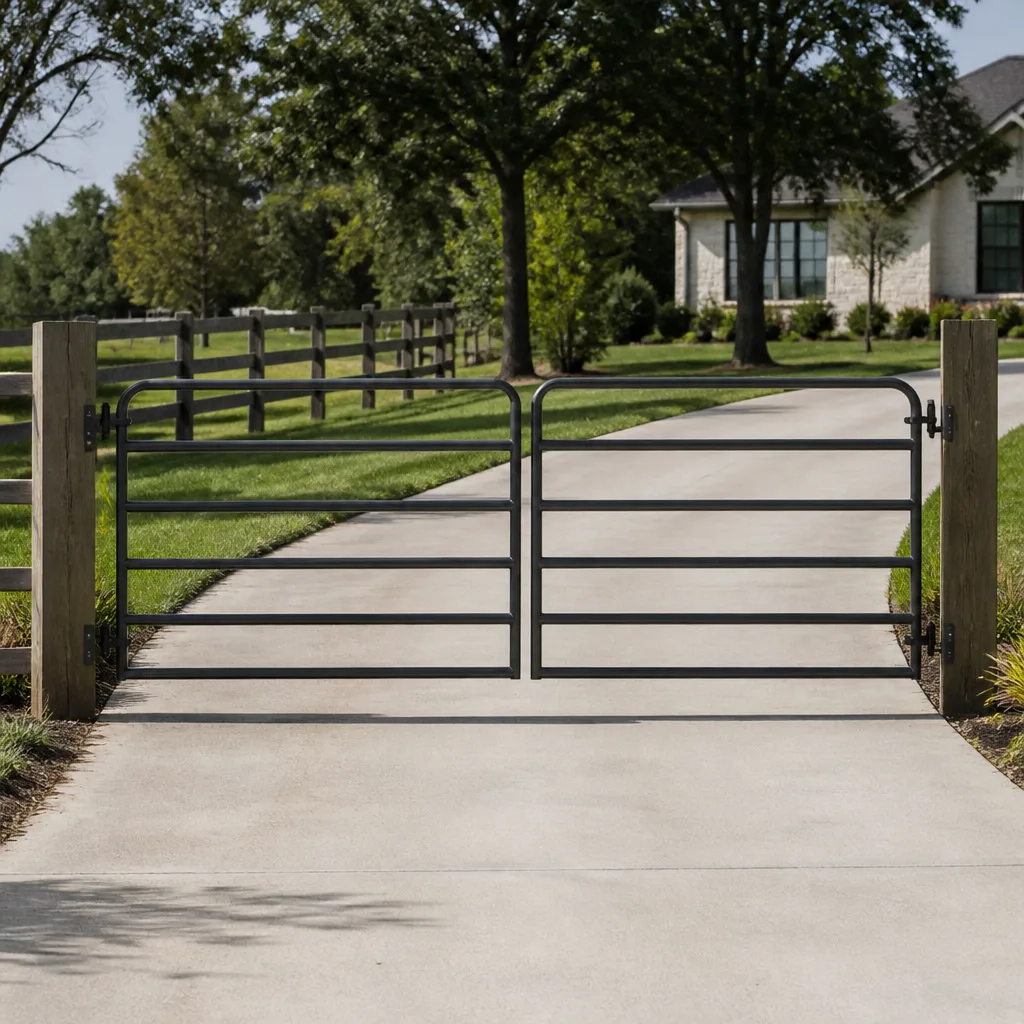 Farm & ranch
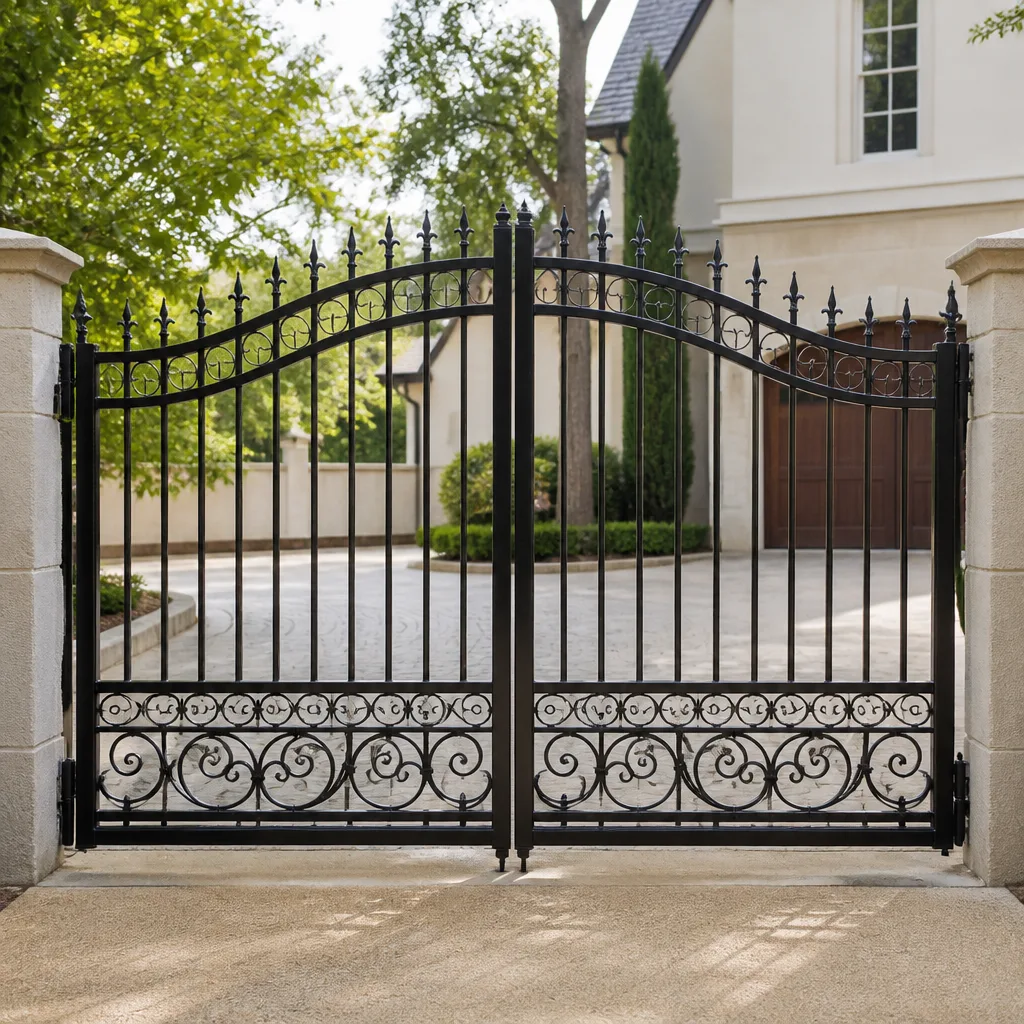 Wrought iron
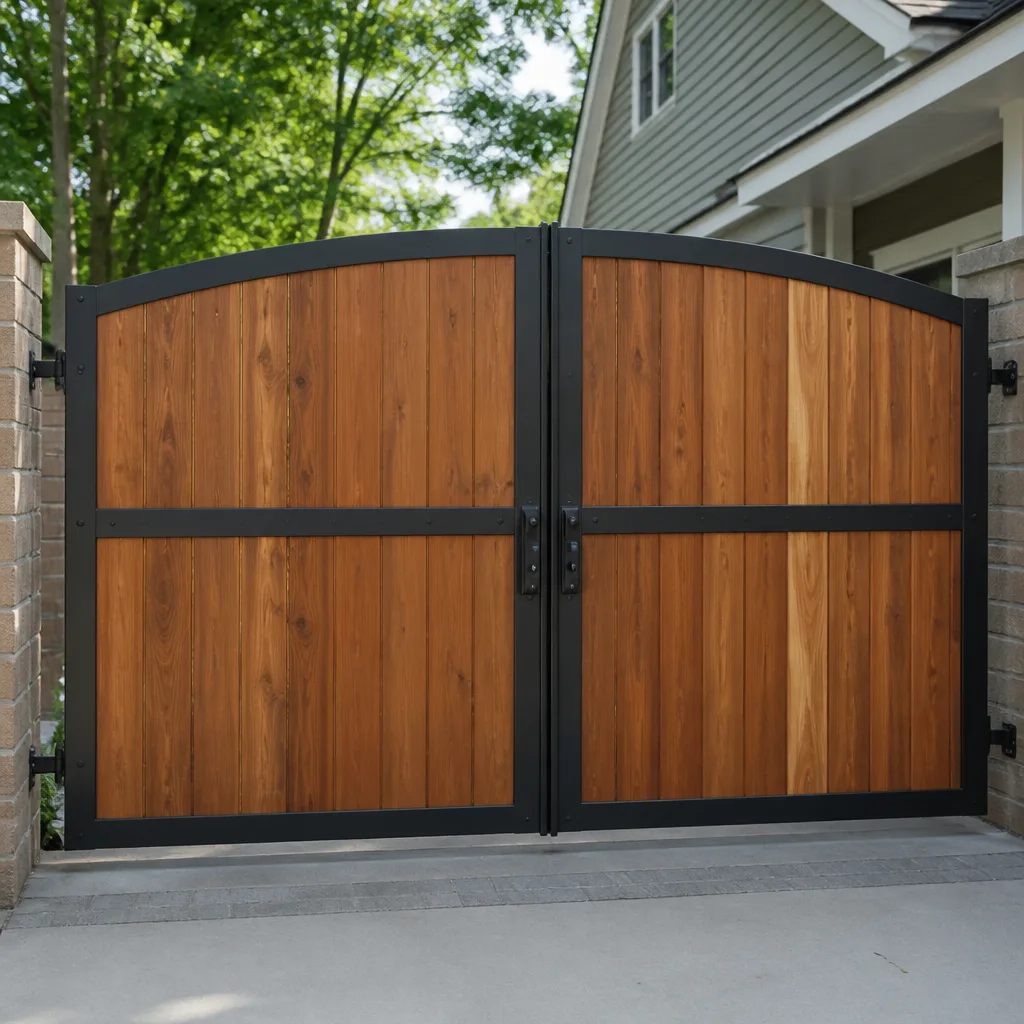 Wood & steel frame
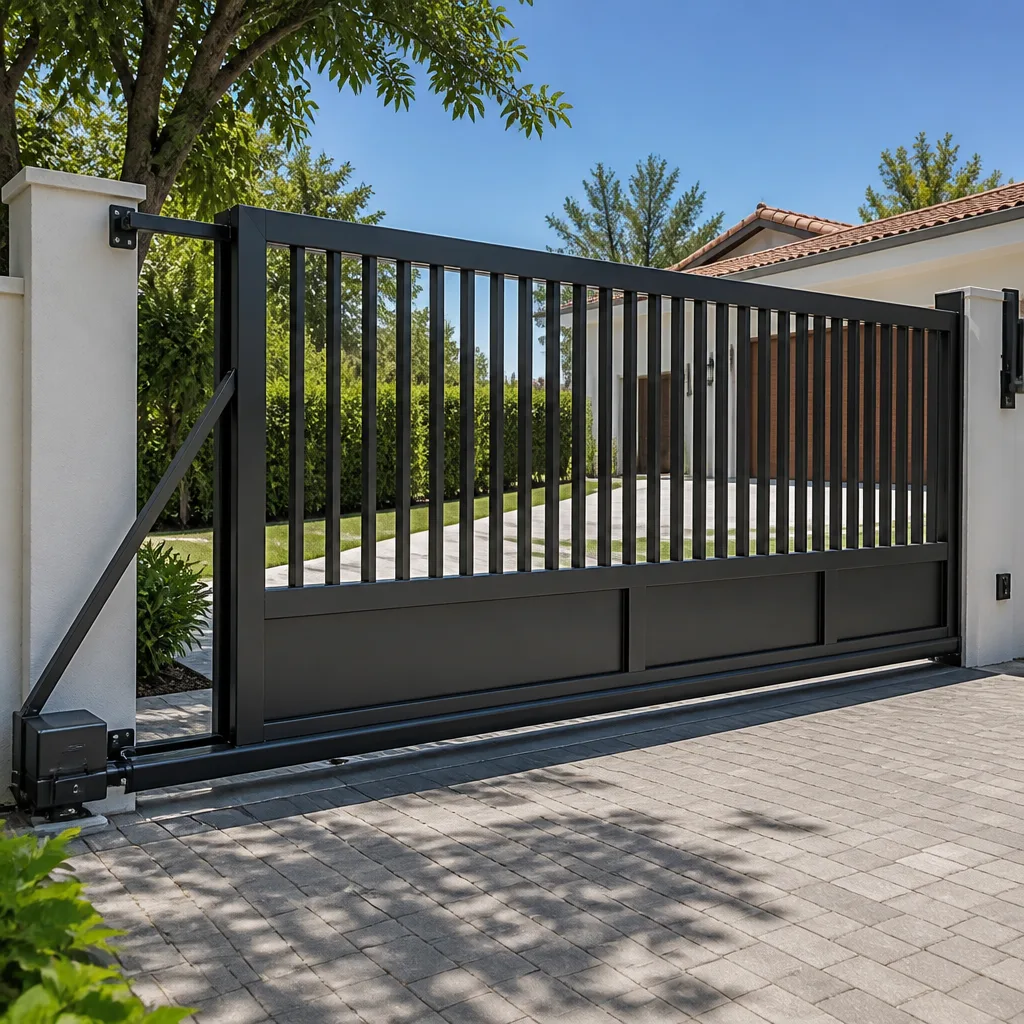 Sliding driveway gates
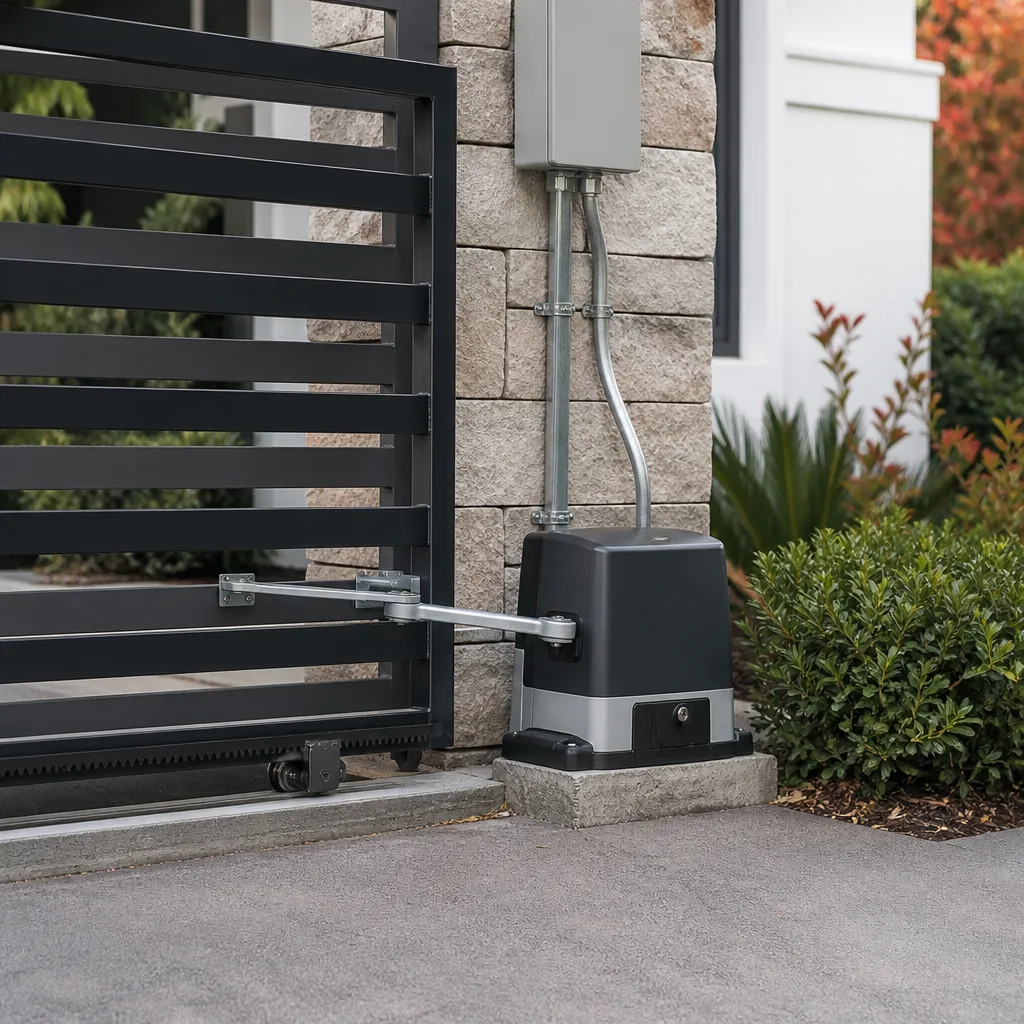 LiftMaster operators
Free on-site gate assessment - hinges, posts, and your LiftMaster or Nice gate operator checked before anything is quoted
The assessment is free and the quote is the invoice.
Get your free estimateGate Repair Emergency Preparedness Guide for Rancho Bernardo Homes
Here’s the counterintuitive truth about automatic gate failures: the gate itself rarely causes the emergency. The operator does. In Rancho Bernardo, where a large share of homes sit behind electric driveway gates on sloping lots off Pomerado Road and Bernardo Heights, a dead operator board or a stripped gear means a 400-pound steel barrier between you and the street. During San Diego’s wildfire-risk power shutoffs, when SDG&E cuts electricity to backcountry-adjacent communities, we get a wave of calls from homeowners who never touched their gate’s manual release until the moment they needed it in the dark. This guide walks you through exactly what to do when your gate fails: how to get out, how to secure your property, and which failures demand a same-day specialist versus a safe overnight workaround.
Quick Answer
Every automatic gate has a manual release mechanism that disengages the operator from the gate leaf, allowing you to push the gate open by hand during a power outage or mechanical failure. The release is typically a red T-handle, a keyed lock, or a pull chain located on or near the operator unit. Before calling for our Gate Repair services in Rancho Bernardo, locate your manual release now, in daylight, because finding it under stress at night with a dead battery is far harder than it sounds.
Styles & brands we work with
- Wrought iron
- Wood & steel frame
- Farm & ranch
- Sliding driveway gates
- LiftMaster operators
Table of Contents
- Scenario One: You Can’t Get Out of Your Property
- Scenario Two: You Can’t Secure Your Property
- Manual Release Procedures by Operator Brand
- Power Outage Preparedness: Battery Backup and Testing
- Temporary Securing Methods That Don’t Damage Your Gate
- Same-Day Emergency vs. Overnight Triage: How to Decide
- What Information to Have Ready When You Call a Specialist
Scenario One: You Can’t Get Out of Your Property
This is the scenario that turns a broken gate into a genuine emergency. You’re in your car, you press the remote, and nothing moves. The operator hums but the gate doesn’t budge, or there’s complete silence. You’re now trapped behind a motorized gate that has failed in the closed position. In Rancho Bernardo, where many homes back up to open space and have no pedestrian exit separate from the driveway, this is a real containment issue. A failed operator on a gate you share with an HOA access road compounds the problem: you may not be able to access the operator housing at all if it’s on common property.
Here’s the step-by-step emergency exit procedure we recommend for both gate types:
Slide Gate: Emergency Exit Procedure
- Turn off the operator. Locate the power switch on the operator unit or flip the dedicated breaker in your panel. You don’t want the motor fighting you mid-release.
- Find the manual release. Most slide gate operators, including LiftMaster and DoorKing units, have a red T-handle or a keyed cylinder on the side of the operator housing.
- Disengage the drive. Pull the T-handle or turn the key a quarter turn. You’ll hear a distinct clunk as the drive gear separates from the rack.
- Push the gate open by hand. Slide gates are heavy, 300 to 600 pounds depending on the length, but once the drive is disengaged they roll on their track. Push slowly from the leading edge, not the middle.
- Prop it open if needed. If the gate is on a slope and wants to roll back, place a wedge or block under a wheel.
What not to do: Don’t force the gate open without disengaging the operator. You’ll strip the gear teeth or snap the drive chain, turning a $200 release-disengagement service call into a $600 operator replacement. And don’t try to use a vehicle to push the gate open. We’ve seen the damage in Rancho Bernardo driveways from that decision. It’s never the cheaper fix.
Swing Gate: Emergency Exit Procedure
- Kill power to the operator. Same first step. Use the dedicated breaker or the operator’s own power switch.
- Locate the manual release lever. On FAAC and Linear swing operators, the release is usually a small lever or knob at the base of the operator arm, or a pull handle on the piston housing.
- Pull the release. You’ll hear the hydraulic piston or mechanical arm disengage. The gate is now free to swing.
- Push from the latch edge. Use steady pressure. Swing gates, especially solid steel or iron ones, have significant momentum once moving. Brace yourself.
- Secure it open. If you’re leaving the property, the gate may want to swing back on its hinges due to slope or wind. A bungee or rope tied to a fixed post works in a pinch.
What not to do: Don’t try to lift a swing gate off its hinges. It’s pinned. Don’t drive through until the gate is fully clear and propped. A half-open swing gate plus a crosswind has damaged more side mirrors in Rancho Bernardo than any other single gate failure mode we’ve documented.
Scenario Two: You Can’t Secure Your Property
The second emergency category is the gate that won’t close. You came home, the gate opened, and then it stopped responding. Now your driveway is open to Pomerado Road, or your courtyard is exposed to the street. In Rancho Bernardo, where lot layouts often place master suites and casitas at the rear of the property with the gate as the only barrier from the sidewalk, a stuck-open gate is a security event. It’s also an invitation: an open driveway gate is a visible signal that something is wrong with the property.
Before you panic, check the obvious. Is there debris in the track? A small branch or a golf-ball-sized rock in the rail will trip the obstruction sensor on most LiftMaster and DoorKing units, keeping the gate open by design. Is the photo eye knocked out of alignment? A misaligned safety beam tells the operator there’s an obstruction, so the gate holds open as a fail-safe. If both of those are clear, you’re likely looking at a failed limit switch, a bad control board, or a dead capacitor in the operator.
In the meantime, here’s how to secure an electric gate that won’t close safely:
- Padlock the frame to the post. On a slide gate, loop a heavy-duty chain or cable lock through the gate frame and around the receiving post. On a swing gate, lock the latch mechanism manually if it has a keyed override.
- Use a drop rod. Slide a steel rod or hefty screwdriver through an opening in the gate leaf and down into a hole in the concrete track. We recommend keeping a galvanized 5/8-inch rod with a bend at the top in the garage for this exact scenario.
- Power down the operator. Cut power at the breaker so the operator doesn’t try to self-close or recalibrate while you’re working around it.
- Don’t improvise with bungee cords or rope as a long-term solution. Rancho Bernardo’s Santa Ana winds will defeat any flexible restraint. A swinging gate under wind load is dangerous and will damage the hinge bearings faster than you’d think.
If you’re on the fence about whether this qualifies as urgent: an unsecured gate overnight in Rancho Bernardo is a liability issue. For an HOA or multi-tenant property, it’s a duty-of-care issue. We treat “gate won’t close and can’t be manually secured” as same-day emergency work. If you’re locked out with a physical padlock and chain, that’s a next-day job. The distinction matters for scheduling.
Manual Release Procedures by Operator Brand
The manual release is the single most important component you don’t think about until it saves you. Every automatic gate operator has one. But the mechanism, the location, and the feel vary significantly by brand. In our experience, the majority of emergency calls we take in Rancho Bernardo involve one of four operator brands: LiftMaster, Apollo, DoorKing, and FAAC. If you can identify which one you have, you’ll know exactly where to look and what to expect when you need it.
LiftMaster Manual Release
LiftMaster slide gate operators, common on Rancho Bernardo’s larger custom lots and equestrian properties off Highland Valley Road, use a red metal T-handle on the side or front of the operator housing. Pulling it rotates a fork that lifts the drive sprocket off the chain. The gate rolls free. The most common failure point on LiftMaster releases is the tension spring that keeps the fork engaged: over time it weakens, and the operator disengages itself mid-cycle. If your LiftMaster gate has started “losing grip” and slipping during operation, that’s the spring, and it’s a quick fix for a technician who knows the part.
Apollo Manual Release
Apollo operators, which we see frequently on medium-sized residential swing gates across Westwood and the Trails, use a pull chain or a key-operated cylinder. On swing models, the release is typically a small lever near the top of the operator arm where it connects to the gate bracket. You pull it up, and the mechanical pawl releases the piston. Apollo’s weak point is the plastic release handle: after about five to seven years in Rancho Bernardo’s dry heat, that plastic gets brittle and cracks off in your hand. If your Apollo release handle feels loose or shifts without engaging, replace it proactively, before you need it during an outage.
DoorKing Manual Release
DoorKing, the workhorse brand on many Rancho Bernardo HOA entry systems and commercial-access gates, has a manual release that’s deliberately simple: a metal lever on the operator frame, usually red or yellow. Pull it, and the chain clutch opens. The specific challenge with DoorKing releases is access: on many HOA and apartment properties, the operator is in a locked enclosure. If you’re a homeowner in a gated Rancho Bernardo community and the entry gate fails, you may not be able to access the release at all, which is why HOA boards should have a clear protocol for who on the block has the key to the operator box. We’ve walked board members through this exact conversation more times than we can count.
FAAC Manual Release
FAAC hydraulic operators, installed on a significant number of higher-end residential swing gates in Bernardo Heights and Green Valley, have a release knob at the end of the piston or a keyed bypass screw on the pump unit. FAAC’s design is elegant when it works, but the bypass screw is small, and if it hasn’t been cycled in years, it seizes. That’s a problem: the moment you need to manually open a FAAC gate is not the moment to discover the release is frozen. We recommend cycling the manual release on any FAAC system every six months, which is also the interval FAAC itself recommends for hydraulic fluid checks. If your system is BFT, the release is similar in concept: a keyed cylinder that disengages the motor from the worm gear. The brand matters less than having someone show you where it is and how it feels when it opens correctly. If your system is FAAC, we know it.
Power Outage Preparedness: Battery Backup and Testing
Rancho Bernardo’s wildfire-risk geography makes power-outage planning a practical necessity, not an abstract exercise. SDG&E’s Public Safety Power Shutoffs have hit the Bernardo area during high-wind red flag periods, and when they do, hundreds of automatic gates either keep working, fail gracefully, or turn into barriers. The deciding factor is almost always battery backup maintenance.
Here’s the maintenance reality that most gate owners miss: the backup battery in your operator is a wear item, like a car battery. It has a service life. In Rancho Bernardo’s climate, where summer garage and operator-box temperatures routinely exceed 110 degrees, lead-acid and AGM gate batteries degrade faster than their rated lifespan. A battery that should last three years may give you 18 to 24 months before it can’t hold a meaningful charge under load.
How to test your backup battery’s health:
- Do a powered-down test. With the gate closed, flip the breaker off. Press your remote. If the gate opens fully and closes fully on battery power, the battery is holding enough charge for basic operation.
- Do a cycle test. A healthy battery should cycle the gate at least three to five times without slowing noticeably. If the gate slows on the second cycle, the battery is marginal.
- Check voltage directly. If you have a multimeter, a healthy 12V battery should read 12.6 to 12.8 volts at rest and not drop below 11.5 volts under load. A 24V system should read double. If you’re not comfortable doing this yourself, this is a quick check for a gate repair specialist to perform during routine service.
- Look at the date. Every sealed battery has a manufacture date printed on the case. If it’s over three years old, replace it preventively. The cost of a replacement battery is a fraction of the cost of an emergency call-out during an outage.
The harder scenario, and the one we get called for during every extended power-outage in Rancho Bernardo, is the dead backup battery. No utility power, no battery power, no gate movement. This is where the manual release becomes your only option. The sequence is identical to the emergency exit procedure in the section above: kill the operator, pull the release, push the gate open. Then assess whether you need to secure the house or leave it buttoned up while you wait for power to return.
One more piece of Rancho Bernardo-specific advice: if your gate is on a hillside lot and you know a Public Safety Power Shutoff is forecast, open your gate proactively before the power cuts. Store the gate in the open position. That way, you’re not fumbling with a release mechanism in your driveway at night with red flag winds kicking dust up. It’s the kind of small preparation that makes a big difference.
Temporary Securing Methods That Don’t Damage Your Gate
When a gate fails open, the instinct is to force it shut. That instinct is usually wrong, and it’s where we see the bulk of self-inflicted damage on Rancho Bernardo gates. A motorized gate is designed to move under its own power. Forcing a slide gate along its track by hand without disengaging the operator strips the rack and pinion. Forcing a swing gate closed while the operator is still engaged damages the piston seals and bends the arm. Before you do anything, disengage the operator. Then the gate is just a heavy door, and it will move freely.
Once the operator is disengaged, here are the securing options that won’t require a follow-up repair:
- Padlock through the frame. On a slide gate, run a hardened steel shank through a vertical frame member and the post. On a swing gate, lock through the latch plate and the post bracket. Use a weather-resistant padlock, not a standard interior deadbolt lock. Rancho Bernardo’s marine layer in the mornings will rust a cheap padlock solid within a single season.
- Install a drop rod into the track. A 5/8-inch steel rod, dropped through a pre-drilled hole in the gate frame and into a concrete sleeve, positively locks a slide gate in place. If your gate doesn’t have a drop-rod hole, this is a retrofit we recommend for every slide gate in Rancho Bernardo as part of a gate installation project, because it gives you a mechanical locking option that works independently of the operator forever.
- Chain and clevis lock. For a swing gate, a heavy chain with a clevis or shackle lock run between the two leafs, or between the leaf and the post, works overnight. Padlock through the clevis.
- Wedge with a purpose-built wheel chock. For a slide gate on a slope that wants to roll, a rubber wheel chock under the leading wheel stops movement. A brick or a 2×4 works in a true emergency but isn’t secure. The gate can climb over it.
What we tell every Rancho Bernardo homeowner: keep a gate emergency kit in the garage. You can find more guides & resources on our blog. A weather-resistant padlock, a six-foot length of 3/8-inch hardened chain, a drop rod if your gate accepts one, and a headlamp. All of it fits in a five-gallon bucket and costs less than one service call. The headlamp matters more than you’d think. Gate operator boxes are almost never well-lit, and doing release work one-handed with a phone flashlight is how bolts get dropped and threads get cross-stripped.
Same-Day Emergency vs. Overnight Triage: How to Decide
Not every gate failure is an emergency. Understanding the difference saves you money, gets genuinely urgent cases moved to the front of the line, and prevents an overnight workaround from becoming a huge problem. We use a simple triage system when Rancho Bernardo homeowners call us with a gate down:
Genuine same-day emergencies
- You’re physically trapped on your property. The gate failed closed, you can’t operate the manual release, and there’s no pedestrian exit. This is a two-person problem: get someone to you and get the gate open.
- The gate failed open on a primary security perimeter. You can’t manually secure it, and the property is exposed. For an HOA or commercial property in Rancho Bernardo, this is urgent.
- The operator is making a grinding, screeching, or repeated-clunking noise. That’s a gear train or drive system destroying itself. Every cycle it runs is doing more damage. Stop using it and call immediately.
- A vehicle or pedestrian impact has knocked the gate off its track or bent the hinge post. A mis-tracked slide gate can fall. A bent hinge post under load can fail catastrophically. Both are safety issues that need immediate attention.
Safe to manage overnight
- The gate failed closed but the manual release works. You can get out and in by hand. Tape a note to the gate so family members don’t panic and start pulling on the gate leaf.
- The gate failed open but you can secure it mechanically. Padlock, drop rod, chain. Secure it, power the operator down, and call in the morning.
- Intermittent operation. The gate works, then doesn’t, then works. It’s likely a failing limit switch or capacitor. You can manage it manually until a technician arrives, but know that intermittent failures often become permanent failures at the worst moment.
- The gate opens but won’t fully close. It’s likely an obstruction-sensor issue, and you’ve already checked the track and photo eyes. You can usually close it manually with the release and secure it for the night.
Here’s our honest advice as a specialist: if you’re on the fence, call and describe what you’re seeing. A 90-second phone call to (855) 532-9392 costs nothing, and our team will tell you straight up whether it’s a come-now problem or a schedule-tomorrow problem. We’d rather talk you through a manual release over the phone at 9pm than show up to a gate that’s been destroyed because someone forced it.
What Information to Have Ready When You Call a Specialist
When you call for gate repair in Rancho Bernardo, the speed and accuracy of the diagnosis depend heavily on what you can tell the technician before they arrive. The more of this you have ready, the faster the fix. Here’s what we ask when you call us:
- Operator brand and model. Look at the operator housing: the brand is usually printed on the side. LiftMaster, FAAC, BFT, Linear, Apollo, DoorKing, Viking, Ghost Controls, Elite, Mighty Mule. If you don’t know the model, a photo of the operator helps.
- Gate type and approximate weight. Slide or swing. Solid steel, iron, aluminum, or wood. Single or double leaf. Heavy gates on small operators are a common Rancho Bernardo mismatch, and knowing the weight helps us understand system stress.
- What the gate is doing. Dead silent. Hums but doesn’t move. Starts then reverses. Opens but won’t close. Moves slower than normal. Grinds. Beeps but doesn’t move. Each symptom points at a different subsystem: board, capacitor, limit switch, gearbox, safety sensor.
- What happened right before it failed. Power outage. High wind. Vehicle impact. Landscaping work nearby. Rain. We’ve traced more than one Rancho Bernardo gate failure to a sprinkler head that got repositioned and started soaking the operator housing.
- Any recent work on the gate or the electrical system. A new panel install, solar work, or a different contractor’s visit can introduce loose connections and changed settings.
- Your access situation. Is there a pedestrian gate? A keypad code? Do you need us to call a specific property manager first? For HOA properties, we need the gate to be accessible or a board member to meet us.
Having this ready converts a 30-minute on-site diagnosis into a 10-minute one. It means the right parts go on the truck the first time. When it comes to electric gate repair, getting the diagnosis right the first time is the whole game.
Common Mistakes to Avoid
- Forcing a gate open without disengaging the operator. We mentioned this before, and it bears repeating. This one mistake turns a simple release into a full operator replacement. A Rancho Bernardo homeowner did this during the 2023 power shutoffs and destroyed a DoorKing slide operator that was otherwise perfectly serviceable.
- Ignoring a slow gate. A gate that’s gradually slowing down over weeks is telling you something: failing capacitor, low hydraulic fluid, a binding hinge, or a motor on its way out. Waiting until it stops dead is the most expensive strategy.
- Never testing the manual release until you need it. The release mechanism seizes, plastic handles crack, keyway cylinders fill with dust and refuse to turn. Cycle it every six months. If it doesn’t move easily, fix it now. In Rancho Bernardo’s dry, dusty summers, un-cycled release mechanisms fail at a predictable rate.
- Using a vehicle to push a gate. Never. The gate loses. The operator loses. The vehicle usually loses too. We’ve replaced gates that were bent into a V shape by an SUV bumper. That’s a four-figure mistake that starts as a two-hundred-dollar service call.
- Spraying WD-40 into the operator housing. WD-40 is a solvent, not a lubricant, and it’s terrible for gate operators. It attracts dust, degrades plastic components, and does nothing for the gear train. Use the manufacturer-specified grease or leave it to a technician. We’ve opened up operator housings in Rancho Bernardo that were gummed solid from repeated WD-40 applications.
- Calling a generalist for an electric gate issue. Electric gate repair is a specialty. A general handyman or a garage door company that “also does gates” may not recognize the difference between a LiftMaster and a BFT board, let alone diagnose one correctly. Brand-specific knowledge means the difference between a $180 capacitor replacement and a $900 board replacement. We work on the brands already on your gate, and we know the failure patterns of each one.
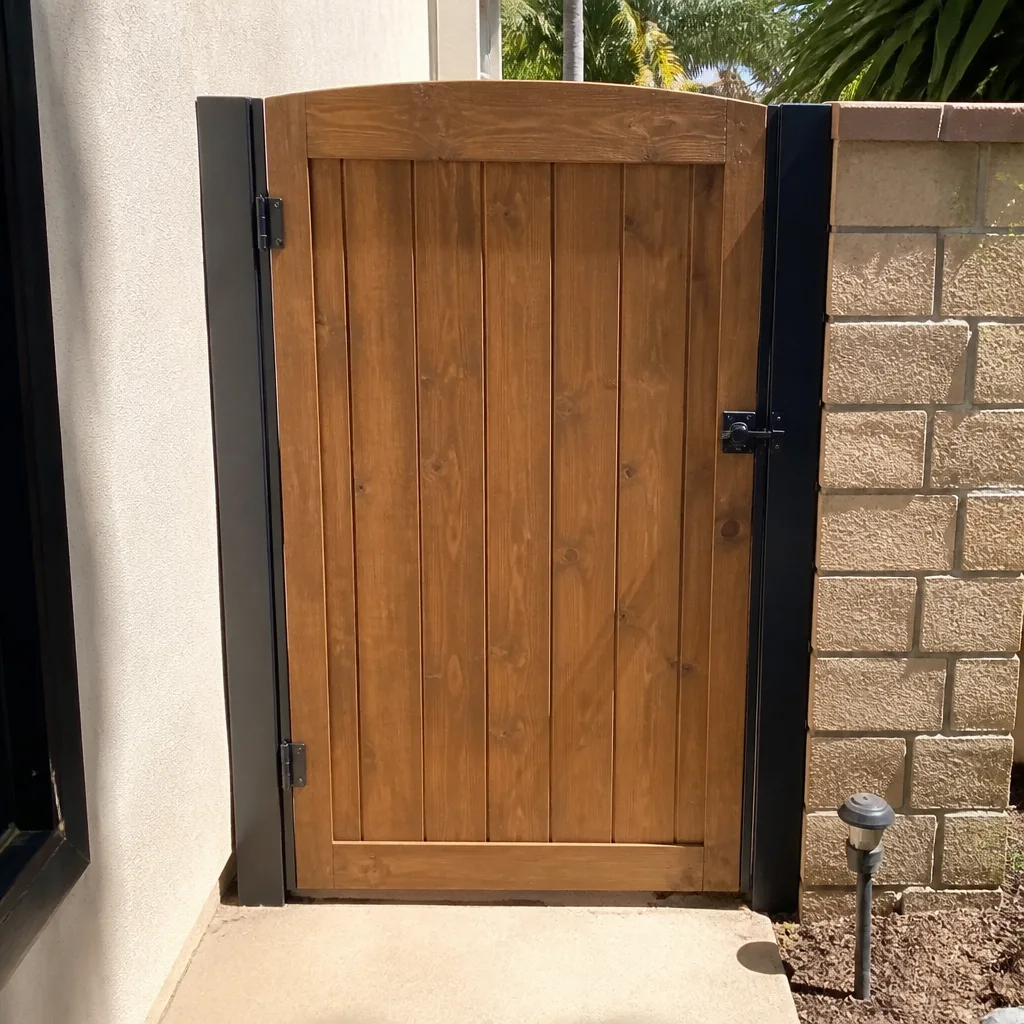
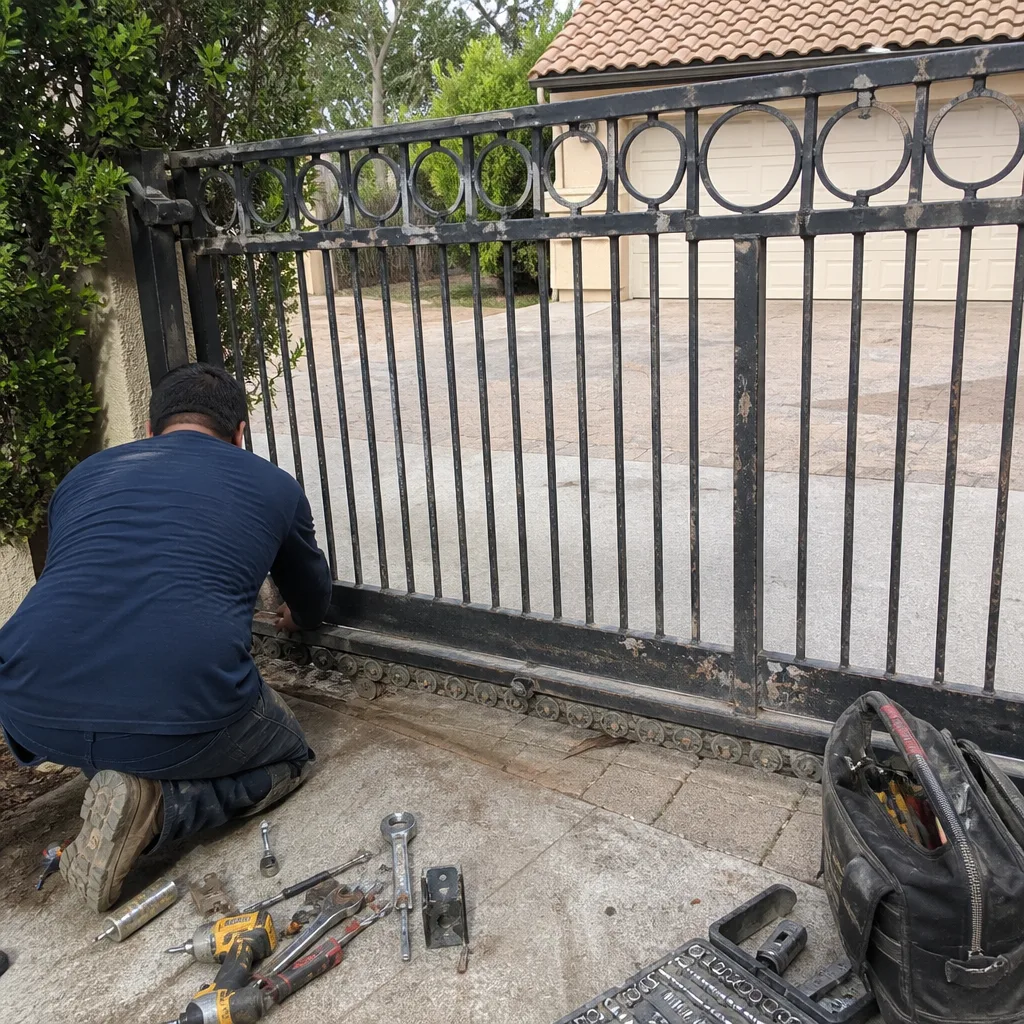
See the difference
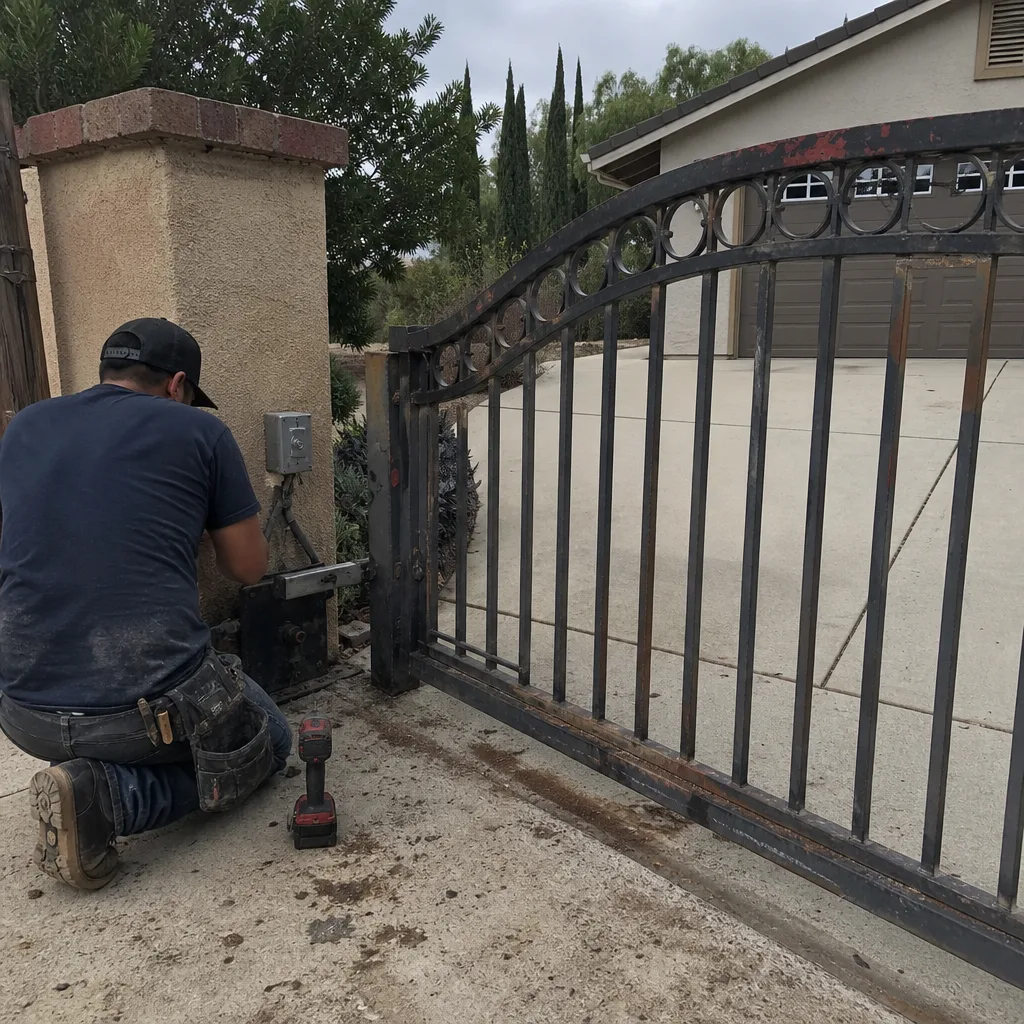 Before
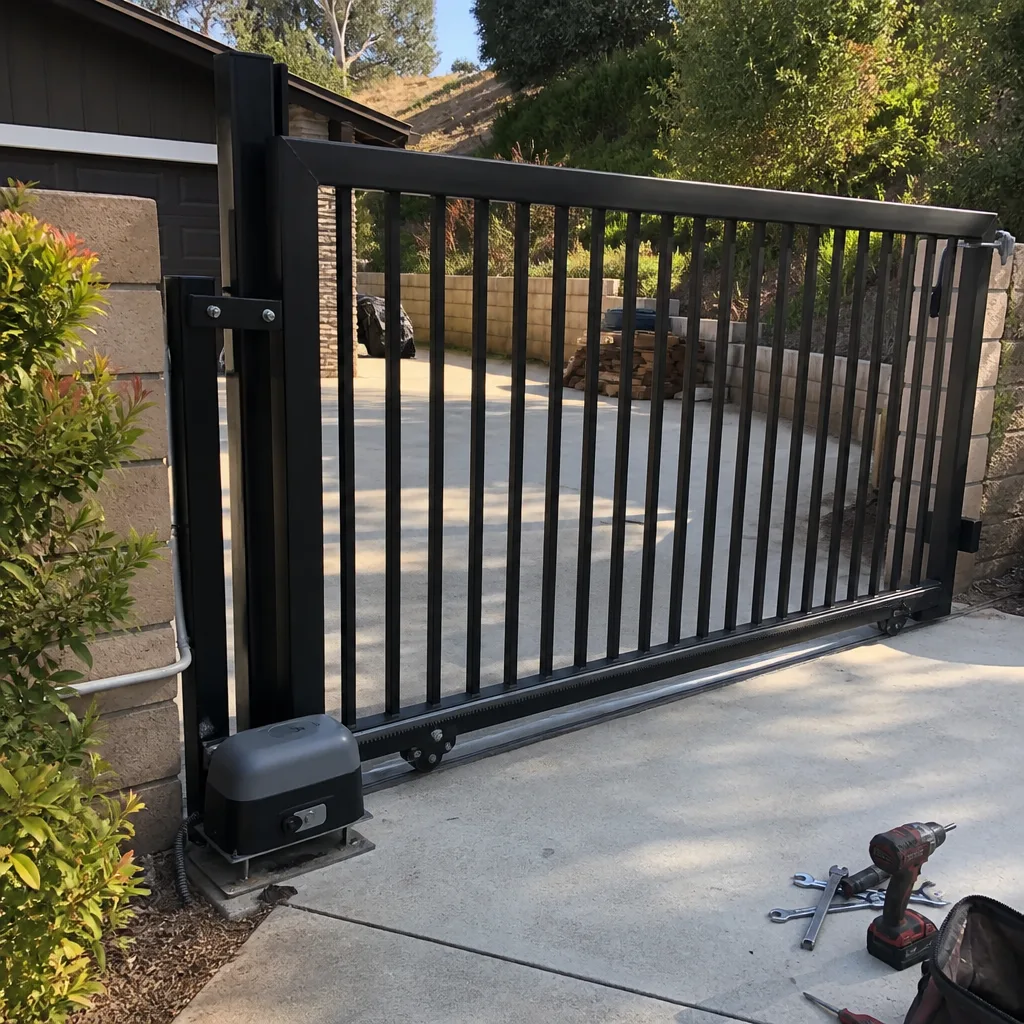 After
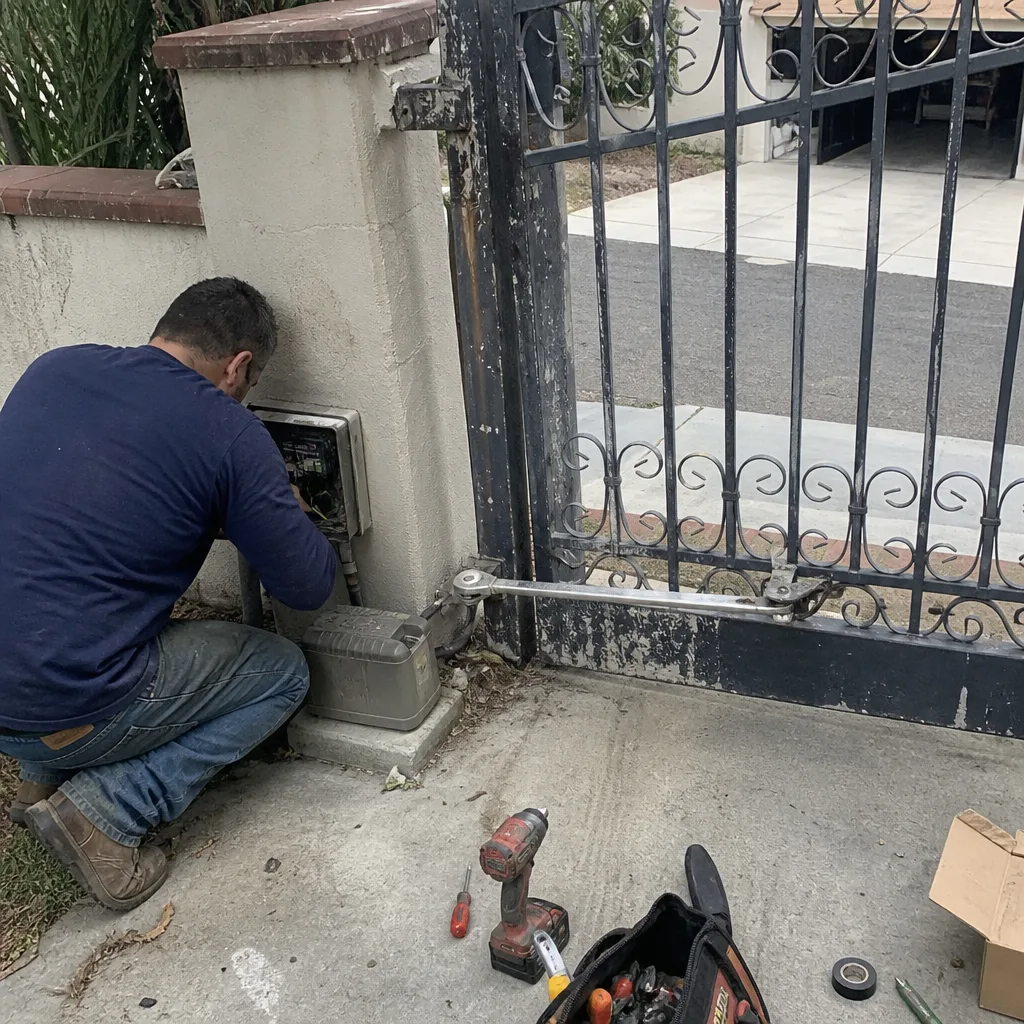 Before
 After
 Before
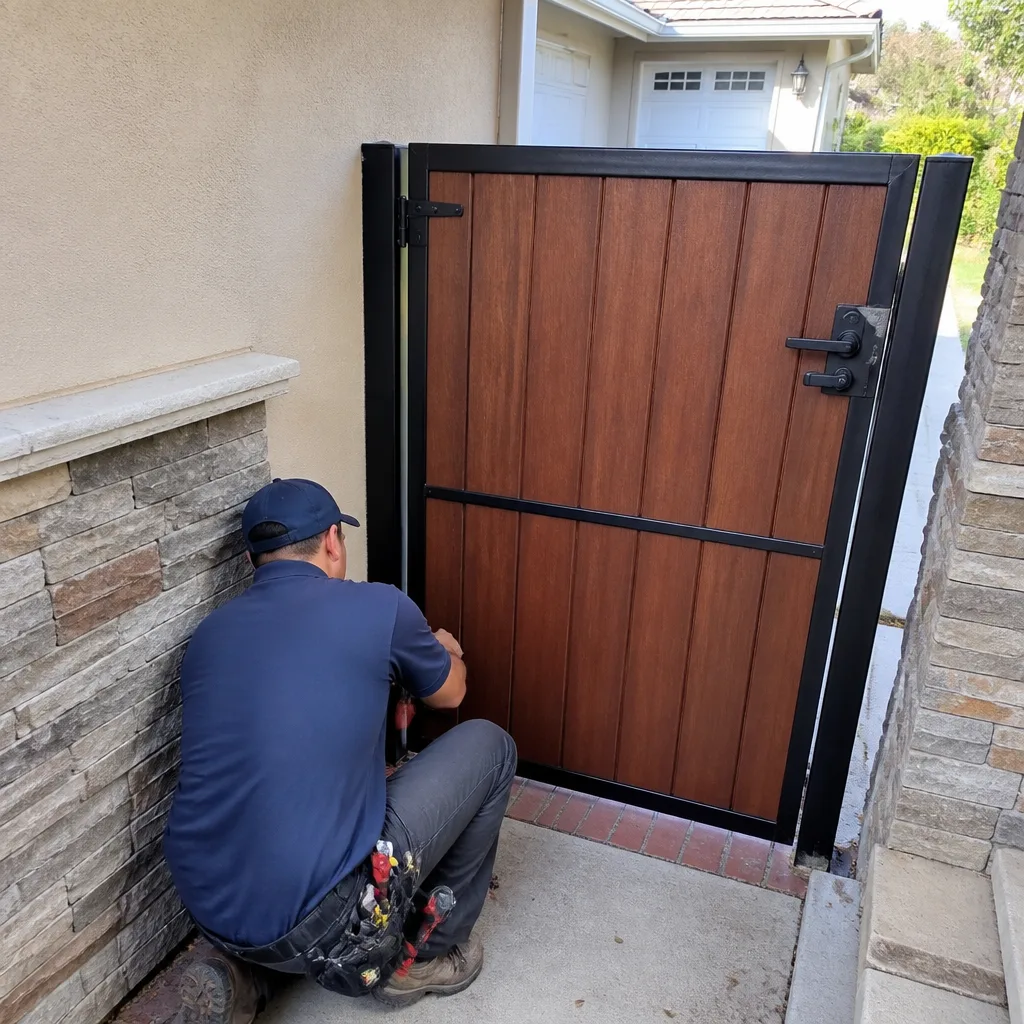 After
When to Call a Professional
If you’ve tried the manual release and it won’t budge, call. If the operator is grinding or smoking, call and shut off power to the unit immediately. If the gate has been hit by a vehicle or has visibly come off its track, call before anyone walks near it; a mis-tracked slide gate can tip without warning. If the gate opens but won’t close and you can’t identify an obstruction, call. If your backup battery is dead and you don’t know how to safely test or replace it, call. Electric gate systems combine lethal voltages, heavy moving mass, and pinch points. We don’t recommend opening an operator housing unless you know what you’re looking at. Gate Repair Rancho Bernardo offers free estimates in Rancho Bernardo and the surrounding communities. Call (855) 532-9392. One call covers the gate and the operator.
Frequently Asked Questions
Turn off the operator at the breaker or the unit’s power switch, then locate the manual release mechanism: a red T-handle, a keyed cylinder, a pull lever, or a chain depending on your operator brand. Pull or turn the release to disengage the operator, then push the gate open by hand. If your release is seized or the handle breaks, leave the operator powered down and call a professional rather than forcing it.
We see two dominant failure modes in Rancho Bernardo: failed capacitors and dead or degraded backup batteries, both of which are accelerated by the area’s sustained summer heat. Capacitors fail from heat exposure inside the operator housing, and batteries degrade faster when ambient temperatures exceed 100 degrees for extended periods. Both are relatively inexpensive to replace, but both will strand you without warning if ignored.
Yes, once the operator is disengaged you can physically secure the gate with a padlock through the frame, a drop rod into the track, or a hardened chain with a clevis lock. The key is to disengage the operator first, so it isn’t fighting the lock or trying to recalibrate while secured. Never attempt to manually force a motorized gate shut without disengaging the drive system first.
Cycle the manual release every six months. Pull it, push the gate a few feet, re-engage it, and confirm the operator takes over smoothly. In Rancho Bernardo’s dry climate, un-cycled releases seize, plastic handles crack, and keyed bypass screws freeze in place. Six months matches the interval most operator manufacturers recommend for general maintenance checks.
Electric gate repair typically costs more than simple mechanical gate repair because it involves diagnosing the operator system, which includes control boards, motors, limit switches, capacitors, and safety sensors. “Electric gate repair” as a specific term generally means the service involves the operator and electrical components, not just the gate structure. A gate repair specialist can give you an accurate price once the symptoms and brand are identified, and estimates are free.
Replace the batteries in the remote first, which resolves a surprisingly high percentage of sudden remote failures. If that doesn’t work, try a second remote or the keypad. If nothing responds from any entry device, the problem is in the operator’s receiver board or antenna, not the remotes themselves. That’s an electric gate repair diagnostic, and it’s where brand knowledge matters. LiftMaster receivers fail differently than FAAC receivers, and a technician who knows both will find the problem faster.
The Bottom Line
A gate failure becomes an emergency when you’re trapped or exposed. Everything else is a schedule-and-manage situation. The single most valuable preparation you can do as a Rancho Bernardo homeowner is to master your gate’s manual release now, in the daylight, while the gate is functioning. The second is to maintain your backup battery, because when SDG&E cuts power during fire weather, that battery is the difference between a functioning gate and a 400-pound barrier. Keep a small gate emergency kit in the garage: padlock, chain, drop rod, headlamp. And know your operator brand, because when you call a specialist, the conversation is faster and the diagnosis is more accurate. For gate repair, electric gate repair, or new gate installation in Rancho Bernardo, call (855) 532-9392. We work on the brands already on your gate, and we get the diagnosis right the first time.
Written by the team at Gate Repair Rancho Bernardo, serving Rancho Bernardo since 2013.