
Last updated November 2, 2026
 Wrought iron
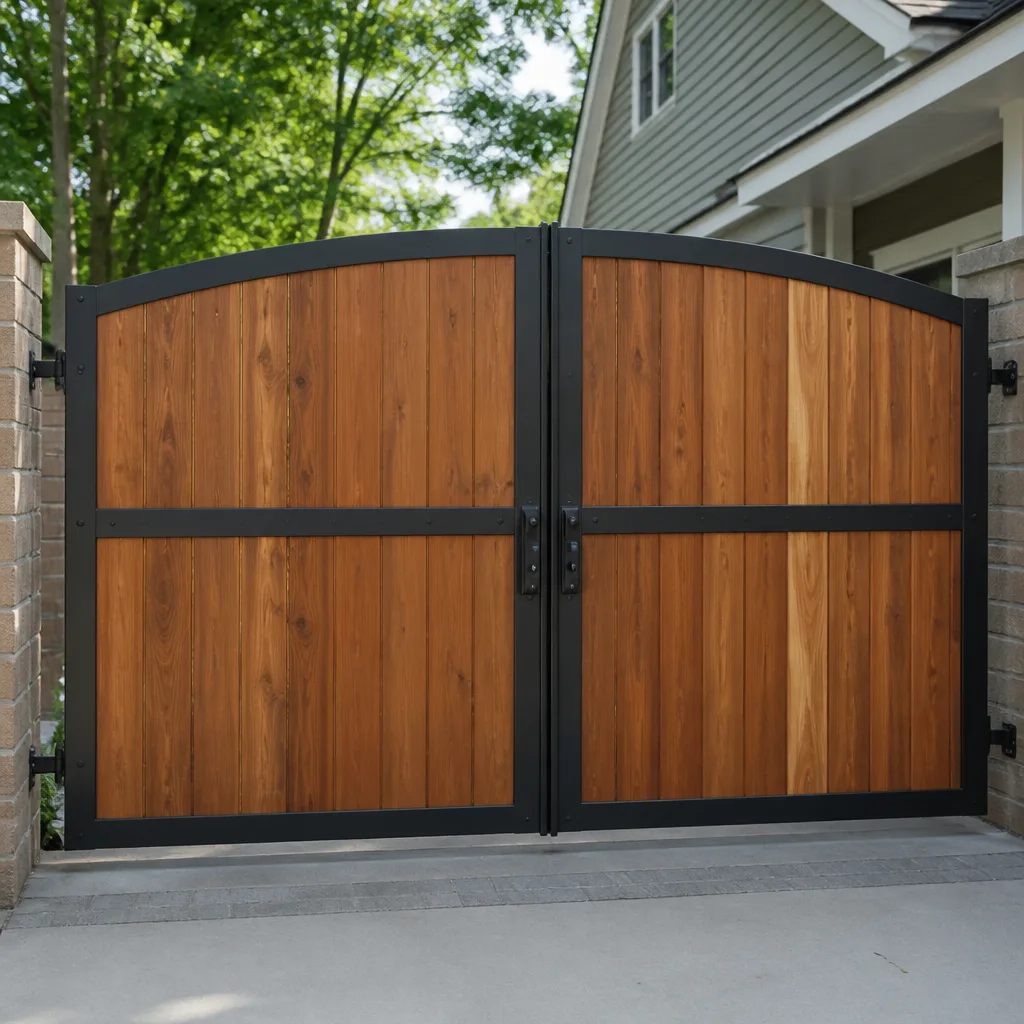 Wood & steel frame
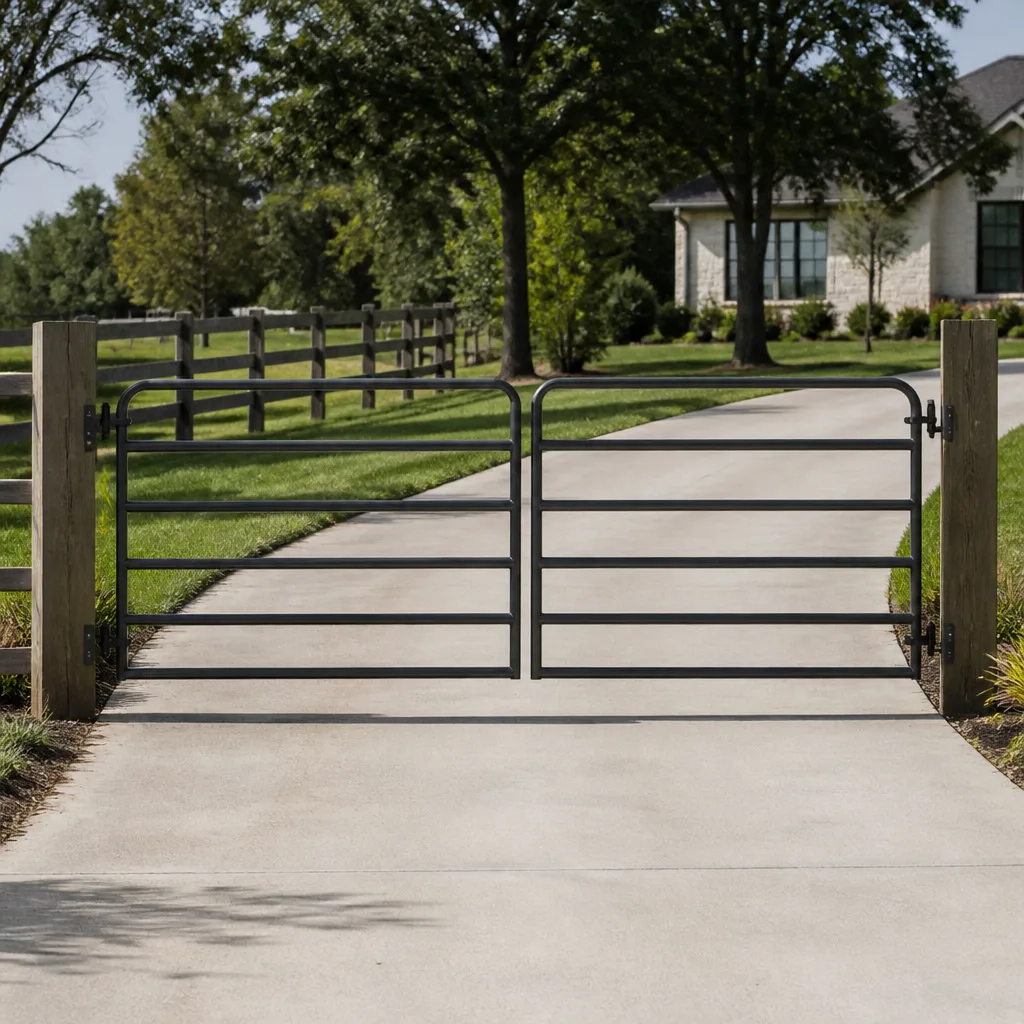 Farm & ranch
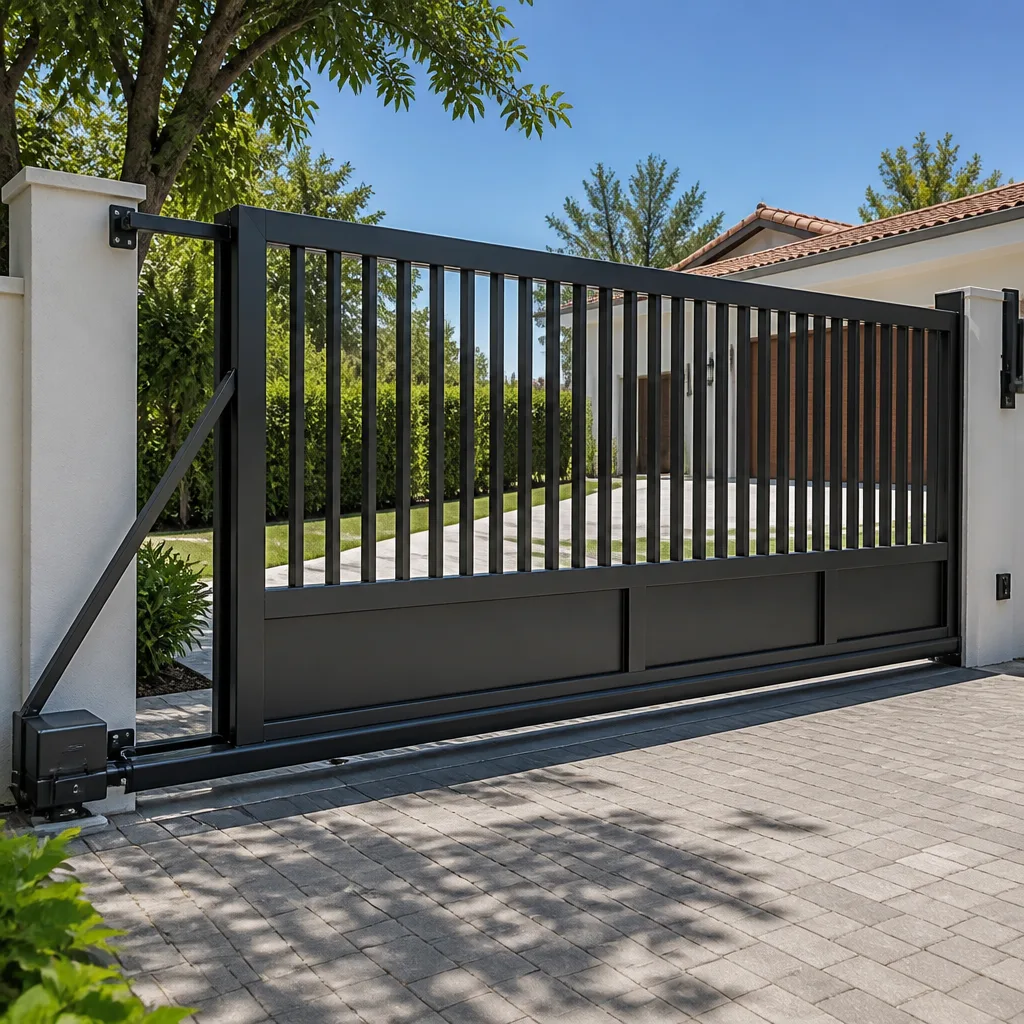 Sliding driveway gates
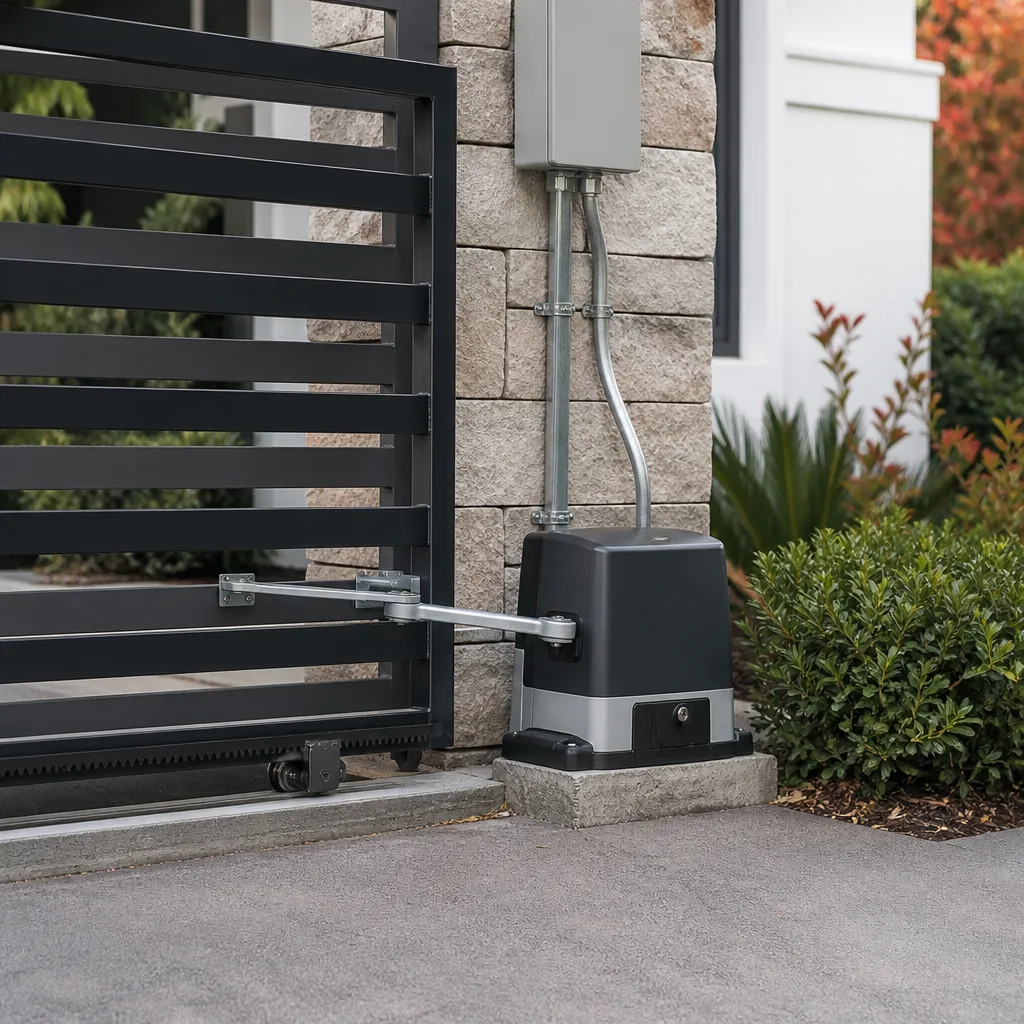 LiftMaster operators
Free on-site gate assessment - hinges, posts, and your LiftMaster or Nice gate operator checked before anything is quoted
The assessment is free and the quote is the invoice.
Get your free estimateGate Repair Troubleshooting: Common Problems and How to Fix Them
Your gate operator is already diagnosing itself. That blinking light on your LiftMaster control board isn’t a decoration, and the pattern of flashes on your FAAC or Linear system isn’t random. It’s a fault code, and it’s telling you exactly which component failed. Most homeowners in Rancho Bernardo never look it up. They call a generalist handyman, get a vague “it’s probably the sensor,” pay for a guess, and end up calling a specialist anyway after the gate fails again two weeks later. This guide breaks down the real diagnostic process we use every day in our Gate Repair services, translated from technician-speak into plain English. You’ll learn how to read your operator’s signals, isolate the fault to a specific component, and know precisely when to stop and call a professional.
Styles & brands we work with
- Wrought iron
- Wood & steel frame
- Farm & ranch
- Sliding driveway gates
- LiftMaster operators
Quick Answer
Gate repair troubleshooting starts with one question: does the gate fail to open, or fail to close? These are almost never the same problem. A gate that won’t open usually points to the receiver, remote, or control board input side. A gate that won’t close typically points to safety sensors, loop detectors, or an obstruction setting. Reading the blink code on your operator’s control board narrows the fault to a specific component in under two minutes.
Table of Contents
- Reading Fault Codes: What Your Operator Is Telling You
- Gate Won’t Open: The Input-Side Diagnosis
- Gate Won’t Close: The Safety-Side Diagnosis
- The $0 Remote Test: Isolating Remote, Receiver, or Control Board
- Loop Detectors and Phantom Reversals on Slide Gates
- Track Alignment and Gate Binding: The Mechanical Side
- Power Supply and Battery Backup Failures
- Common Mistakes to Avoid
- When to Call a Professional
- Frequently Asked Questions
- The Bottom Line
Reading Fault Codes: What Your Operator Is Telling You
Every modern gate operator runs a continuous self-diagnostic. When something fails, the control board logs a fault and flashes an LED in a specific sequence. LiftMaster systems, for instance, flash the diagnostic LED on the control board in patterns that correspond to specific failures: a single repeated flash often indicates a stuck or missing limit switch on the open side, while a double flash points to a close-side limit problem. Linear operators use a similar convention, though their boards often include a small digital readout instead of just an LED. FAAC systems are a bit different. Many FAAC boards (like the 455 D and 391 series) drive fault reporting through a plug-in programmer module or display, and technicians who don’t work on FAAC regularly miss the nuances of the error table entirely.
This is where brand familiarity saves hours. A LiftMaster fault code on an HCT or CSL24V model means something very different from the same blink pattern on a LA500 or an older SL3000. When we spend time in Rancho Bernardo neighborhoods like The Trails or High Country West, the most common residential installs we see are LiftMaster swing and slide operators, linear actuators on older custom gates, and FAAC systems on pre-2010 builds. Each brand has its own diagnostic language.
Common Fault Code Patterns
- Single flash repeating: Limit switch not registering on the open or close side. The gate either can’t find its end point or is running past it.
- Double flash repeating: Motor current sense trip. The operator is working harder than normal, which usually means the gate is binding or hitting an obstruction.
- Three flashes: Safety input active or faulted. A photo eye, edge sensor, or loop detector is telling the board to reverse or hold.
- Four flashes: Receiver or wireless signal issue. The board isn’t seeing a clean signal from the remote or keypad.
- Solid LED, no flash: Power is on, no fault logged. The issue is likely in wiring, a toggle switch, or a remote battery.
Write down the flash pattern before you touch anything else. Cycle power once and see if the code clears or repeats. A code that returns immediately points to a hard fault. A code that only appears after the gate moves points to something mechanical or sensor-related that triggers under load.
One caution we repeat often in Rancho Bernardo: never reset a control board by disconnecting and reconnecting power half a dozen times in a row. It clears stored fault history you might need, and on some LiftMaster and Linear boards it can trigger a factory reset if done incorrectly. You’ll lose your learned remote codes and limit settings, and now you’ve created a new problem while chasing the original one.
Gate Won’t Open: The Input-Side Diagnosis
When a gate won’t open, you’re dealing with the input side of the system: remote, keypad, vehicle sensor, receiver, or the control board’s input terminals. The operator motor itself is rarely the failure point here, but it gets misdiagnosed as “a bad motor” constantly. Here’s the systematic way to isolate the input fault.
- Test the remote. Stand within 20 feet of the receiver antenna. If the remote has never worked well at a given distance, you may have a receiver or antenna placement issue. If the remote works occasionally, replace the battery. It’s obvious, but we see Rancho Bernardo homeowners chase “gate problems” that were a $6 key fob battery.
- Watch the control board. Press the remote. Does the input LED on the board blink or flash? If yes, the receiver and remote are working, and the board is receiving the signal. The fault is elsewhere (a limit switch, a safety input hold, or a relay that’s failed). If no LED response, the remote signal isn’t reaching the board.
- Test the keypad or hardwired opener button. If the keypad opens the gate but the remote doesn’t, the problem is the remote or receiver. If neither works, the problem is downstream of the receiver: a wiring issue, a board input failure, or a safety loop that’s holding the gate closed.
- Check the manual release. Can you disengage the operator and move the gate by hand? A gate that won’t budge manually has a mechanical obstruction or a broken hinge. A gate that moves freely by hand but won’t move under power points to the operator or control board.
If the board shows no response from any input, and the gate moves freely by hand, the control board’s input circuit may be dead. On older boards this is repairable; on newer sealed boards it’s usually a replacement. We stock or source control boards for LiftMaster, FAAC, BFT, and Linear systems, so we don’t have to order and wait for a part to ship when a Rancho Bernardo gate is down.
Gate Won’t Close: The Safety-Side Diagnosis
A gate that opens fine but refuses to close is almost always a safety circuit doing its job. Automatic gates are required to reverse or refuse to close when a photo eye, edge sensor, or loop detector reports an obstruction. That’s by design, and it’s not a fault. The fault is whatever is triggering the safety input when it shouldn’t be.
Start with the photo eyes. These are the two small sensors mounted on either side of the gate opening, usually a few inches off the ground. One sends an invisible beam, the other receives it. If the beam is blocked, misaligned, or dirty, the board sees an obstruction and refuses to close. Clean the lenses with a dry cloth. Check that both sensors point directly at each other. In Rancho Bernardo, dust from decomposed granite landscaping and cobwebs are the most common culprits, plus the occasional overgrown ice plant or bougainvillea branch hanging into the beam path.
Next, check edge sensors. If your gate has a rubber safety edge along the leading edge, press it with your hand. A stuck or compressed edge sensor (often from a windy day slamming the gate or from years of sun exposure hardening the rubber) can show a permanent obstruction signal. On some FAAC and BFT systems, the edge sensor is a resistive loop, and any break in the loop shows the same as a triggered sensor.
Finally, look at the loop detectors. Slide gates use inductive loop detectors buried in the driveway to sense vehicles. A loop detector that’s mis-tuned or has a broken wire can show a constant vehicle presence on the “inside” or “outside” loop, which tells the board to hold the gate open. This is the source of the “phantom vehicle” problem that drives property managers in Rancho Bernardo HOAs up the wall.
The $0 Remote Test: Isolating Remote, Receiver, or Control Board
You can isolate the fault to the remote, receiver, or board without a single tool, and without spending a dime. Here’s the method we walk through on the phone with Rancho Bernardo customers who call us before scheduling a visit.
- Stand at the gate operator with the remote. Press the remote button while watching the control board. Most boards have an LED labeled “RADIO” or “INPUT” or “LEARN” that lights when a signal is received. If it lights, the remote and receiver are functioning, and the problem is downstream in the board or motor circuit.
- If no LED, move the remote closer. Hold it within 12 inches of the control board and press again. A remote that works at 12 inches but not 30 feet usually means a weak remote battery or a receiver antenna issue. A remote that doesn’t work at 12 inches points to a failed remote, a dead battery, or a receiver that’s lost its programming.
- If the remote works close but not far, check the antenna. On LiftMaster and Linear operators, the receiver antenna is a small wire extending from the control board. If it’s been bent, pinched, or pulled inside the operator housing, range drops dramatically. Straightening the antenna often restores normal range.
- Cycle the receiver. If the board has a “LEARN” button, press and release it once. On some boards this resets the receiver for a learning window; if your remote suddenly works after this, the receiver had lost its memory and re-learning the remote resolves it.
If none of these steps produce a response, the receiver module may be faulty, or the control board’s input circuit may have failed. Both are replacement-level repairs that a gate specialist can confirm with a meter in a few minutes.
Loop Detectors and Phantom Reversals on Slide Gates
Slide gates are the most common automatic gate type in Rancho Bernardo, particularly on the larger lots in Green Valley and the equestrian properties off Highland Valley Road. Slide gates rely on inductive loop detectors buried under the driveway to sense when a vehicle is present. These are not edge sensors or photo eyes. They work by creating an electromagnetic field that changes when a mass of metal (your car) passes over it.
The loop detector tells the operator: hold the gate open while a vehicle is present, and don’t close while a car is still in the loop area. When a loop detector fails, mis-tunes, or has a broken wire, it produces what we call phantom events. The gate opens by itself at 3 a.m. The gate starts closing while a car is still in the driveway. The gate reverses midway through opening for no visible reason. The gate stays open for 20 minutes and then suddenly slides shut.
These symptoms get misattributed to “a bad control board” or “a haunted gate” more often than we can count. The loop detector is typically the last thing a generalist technician checks, because loop testing requires a specialized meter and an understanding of inductance tuning. We test loop detectors on every slide gate service call, even when the customer reports a different problem, because loop faults show up in strange ways.
Here’s a simple loop sanity check: if you hold the remote button and the gate opens, but it immediately starts closing the moment you release the button instead of waiting for the vehicle to clear, your loop detector is not reporting properly. The board is treating your driveway as empty because the loop isn’t registering your car. On a properly working system, the gate should hold open while a vehicle is sitting on the loop.
Loop repairs involve re-splicing a broken wire, replacing a detector module, or in some cases cutting and re-pouring the loop in the driveway. It’s not a job for a weekend DIYer, and we tell every Rancho Bernardo homeowner this: if your slide gate behaves unpredictably in the presence of vehicles, call a gate specialist before you call anyone else.
Track Alignment and Gate Binding: The Mechanical Side
Not every gate problem is electrical. A slide gate that opens halfway and stops, or a swing gate that labors and groans, is often fighting a mechanical problem that’s been developing for months. The operator tries to move the gate, meets resistance, and protects itself by stopping or reversing. The fault code may point to a motor current trip, but the root cause is mechanical.
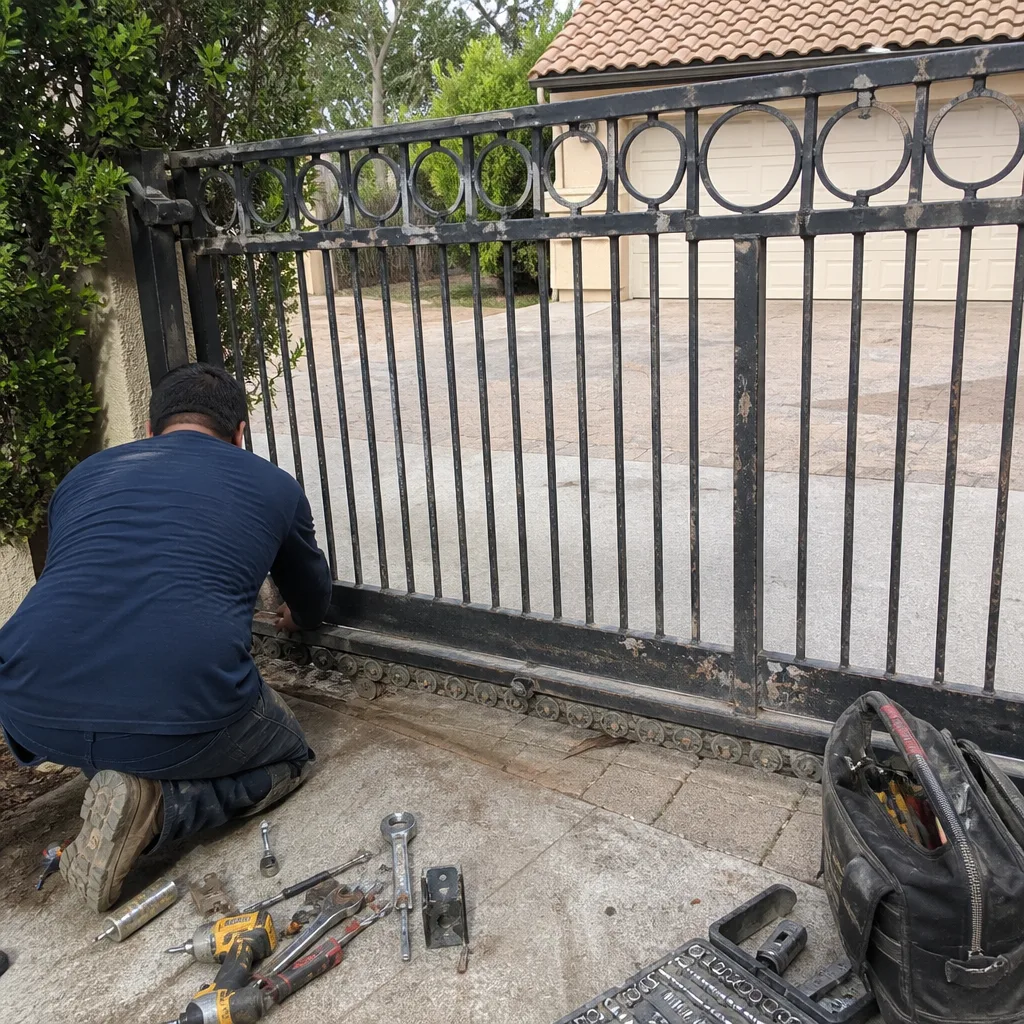
For slide gates, the primary culprits are worn rollers, misaligned track, and debris in the track channel. Rancho Bernardo’s decomposed granite soil and eucalyptus leaf debris work their way into the track over time. The gate gradually starts riding up on one side, the roller bearings wear, and the motor has to work harder to pull the same gate that used to move easily.
Run your hand along the track. Look for flat spots on the rollers, rust streaks, or areas where the track is visibly out of parallel. Check the gate wheels themselves. A proper slide gate rolls smoothly with fingertip pressure when the operator is disengaged. If you have to shove it, the motor is doing work it shouldn’t.
For swing gates, the same principle applies to hinges. A sagging swing gate puts load on the operator’s arm or piston that the system wasn’t designed for. On a LiftMaster swing operator, you might see a fault for “force limit exceeded” that has nothing to do with the operator itself and everything to do with a hinge that’s failed after ten summers of Rancho Bernardo heat.
Disengage the operator and test the gate manually. This is the single most revealing step in gate repair troubleshooting, and it costs nothing. A gate that moves freely by hand but fails under power is an operator or control problem. A gate that’s stiff, catches, or won’t move manually is a mechanical problem. People skip this step constantly, and it’s the fastest way to avoid paying a technician to diagnose the wrong thing.
Power Supply and Battery Backup Failures
Gate operators run on low-voltage DC power supplied by a transformer or a battery with a charging circuit. When the power supply fails, the whole operator goes dark: no lights, no response, no fault codes. But power issues aren’t as simple as “is it plugged in,” especially in Rancho Bernardo, where we see specific patterns tied to the local environment.
Many Rancho Bernardo homes have gate operators on dedicated circuits, often fed from a subpanel in the garage or on the side of the house. If the breaker trips, the gate is dead. But check this: if the gate is on a GFCI-protected circuit, it may have tripped at the outlet. A GFCI outlet on the exterior of your home, exposed to morning condensation from the coastal layer, is the most common single-point failure we see for gates that are “suddenly dead.” Reset the GFCI before calling us. It’s a three-second fix that saves a service call.
Battery backup systems are a different story. Many modern operators, particularly commercial-grade LiftMaster and BFT units, run on battery power with a charging circuit that keeps the battery topped up. When the battery fails after 3 to 5 years, the gate may work while the transformer is supplying power but dead the moment power drops. Or the gate may move slowly, or the operator may log repeated low-voltage faults.
If your gate works but seems sluggish, and the operator is more than four years old, the battery is a likely suspect. We replace batteries on LiftMaster, FAAC, BFT, and Linear systems, and we check the charging circuit while we’re in there. A new battery on a failing charger is another failure in six months, so we test both.
For electric gate repair in Rancho Bernardo, power supply diagnosis is step one. It’s not glamorous, but it’s the difference between an accurate repair and a guess.
Common Mistakes to Avoid
- Resetting the control board before reading the fault code. The fault code is the diagnosis. Erase it and you’re flying blind. Write it down, then reset.
- Replacing the remote before testing the receiver. A remote that “doesn’t work” is often a receiver that lost its programming or an antenna that’s been pinched. We see Rancho Bernardo customers buy new remotes for $60 each when the fix was a 30-second re-learn.
- Ignoring manual gate movement testing. Disengaging the operator and pushing the gate by hand answers more questions than ten minutes of visual inspection. A gate that moves freely by hand is not a mechanical problem.
- Oiling or greasing the track or hinges without cleaning first. Oil on dusty decomposed granite creates an abrasive paste that eats rollers and bushings. Clean the track, then lubricate sparingly, or don’t lubricate at all.
- Setting force limits to maximum to “fix” a slow gate. If the gate is binding, raising the force limit makes the operator push through it. You might get a few more months, but the mechanical problem is getting worse, and eventually the operator motor burns out or the gate breaks a hinge.
- Crank up photo-eye sensitivity to solve false triggers. A photo eye that triggers randomly is usually misaligned or dirty, not too sensitive. Changing sensitivity settings masks the real problem.
- Ignoring gradual changes in gate speed or sound. A gate that’s sliding slower, or a swing gate that sounds different, is telling you something. The operators designed to move a specific load. When that load changes, something is wearing. Catch it early and the repair is affordable.
When to Call a Professional
Some gate problems are not DIY territory, and knowing where that line is saves time, money, and potential injury. Call a gate specialist if you see any of these: the control board shows a fault you can’t identify (see our Gate Repair Warning Signs: A Rancho Bernardo Homeowner’s Reference Guide), the operator motor runs but the gate doesn’t move, the gate has come off the track, a hinge or weld has cracked, you smell burning plastic or electrical, the gate is sparking, or the system is a commercial access-controlled entry point with live wiring and a master controller.
Automatic gates are powerful machines. A slide gate can weigh 800 pounds and produce enough force to cause serious injury if a component fails while you’re working on it. We take that seriously. Gate Repair Rancho Bernardo offers free estimates in Rancho Bernardo, and we work on the brands already on your gate. Call (855) 532-9392.
Frequently Asked Questions
Gate repair in Rancho Bernardo typically ranges from $150 to $500 for common fixes like photo eye replacement, receiver re-programming, limit switch adjustment, or loop detector replacement. Control board replacement runs $400 to $1,200 depending on brand and model. The exact price depends on what we find during diagnosis, and it’s always quoted and agreed before any work starts. Call (855) 532-9392 for an exact quote. Estimates are free.
Yes. We prioritize emergency gate failures and same-day service in Rancho Bernardo for gate repair and electric gate repair calls that involve a security or access issue. If your gate is stuck open, stuck closed, or refusing to operate, call (855) 532-9392 and we’ll get you on the schedule immediately.
Yes. We work on LiftMaster operators across residential and commercial lines, including the LA500, CSL24V, and HCT models. We stock and source LiftMaster parts, and we’re familiar with the specific fault codes and programming procedures for the brand.
Yes. FAAC and BFT are two of the brands we see regularly on Rancho Bernardo properties, and both require brand-specific knowledge to diagnose correctly. We service and repair both brands, and we don’t misdiagnose them as “too old to fix” the way some generalists do.
Yes. One call covers the gate and the operator. We work on the mechanical gate structure (hinges, rollers, track, welding) and the electric system (operator, control board, sensors, loop detectors, remotes), so you’re not coordinating between a gate fabricator and an automation tech.
Yes. We handle gate installation in Rancho Bernardo, including new operator installation on existing gates, complete new gate and operator systems, and brand conversions when a customer wants to move from one manufacturer to another. We’ll measure the gate, assess the structure, and provide a written quote before any work begins.
The Bottom Line
Gate repair troubleshooting is a process of elimination, and the process works best when you read what the gate is already telling you. The fault codes, the open-vs-close distinction, the manual movement test, and the loop detector check will resolve the majority of problems without a service call. When those steps point to a component failure you can’t fix from the driveway, the smart move is a specialist who knows your brand. Gate Repair Rancho Bernardo works on LiftMaster, FAAC, BFT, and Linear systems every day. One call covers the gate and the operator, and the diagnosis is right the first time.
Written by the team at Gate Repair Rancho Bernardo, serving Rancho Bernardo since 2013.
See the difference
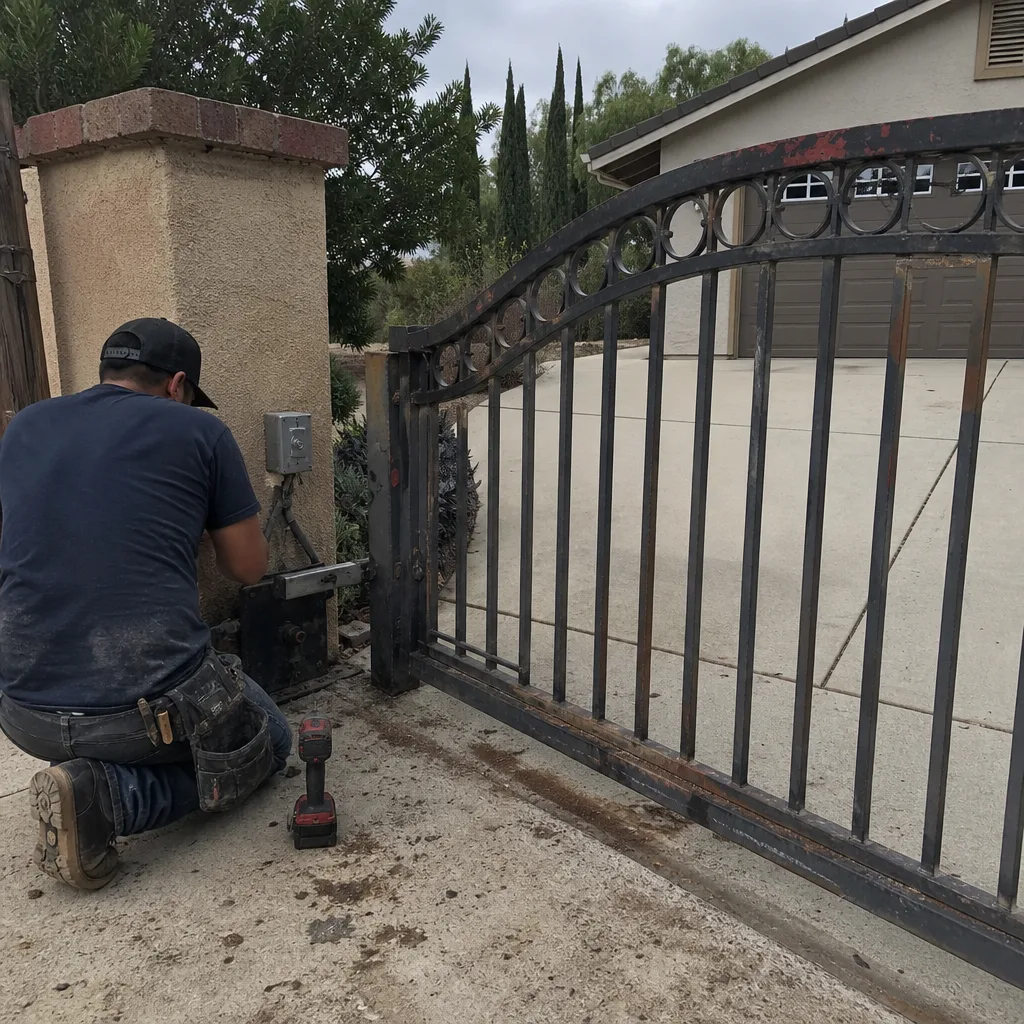 Before
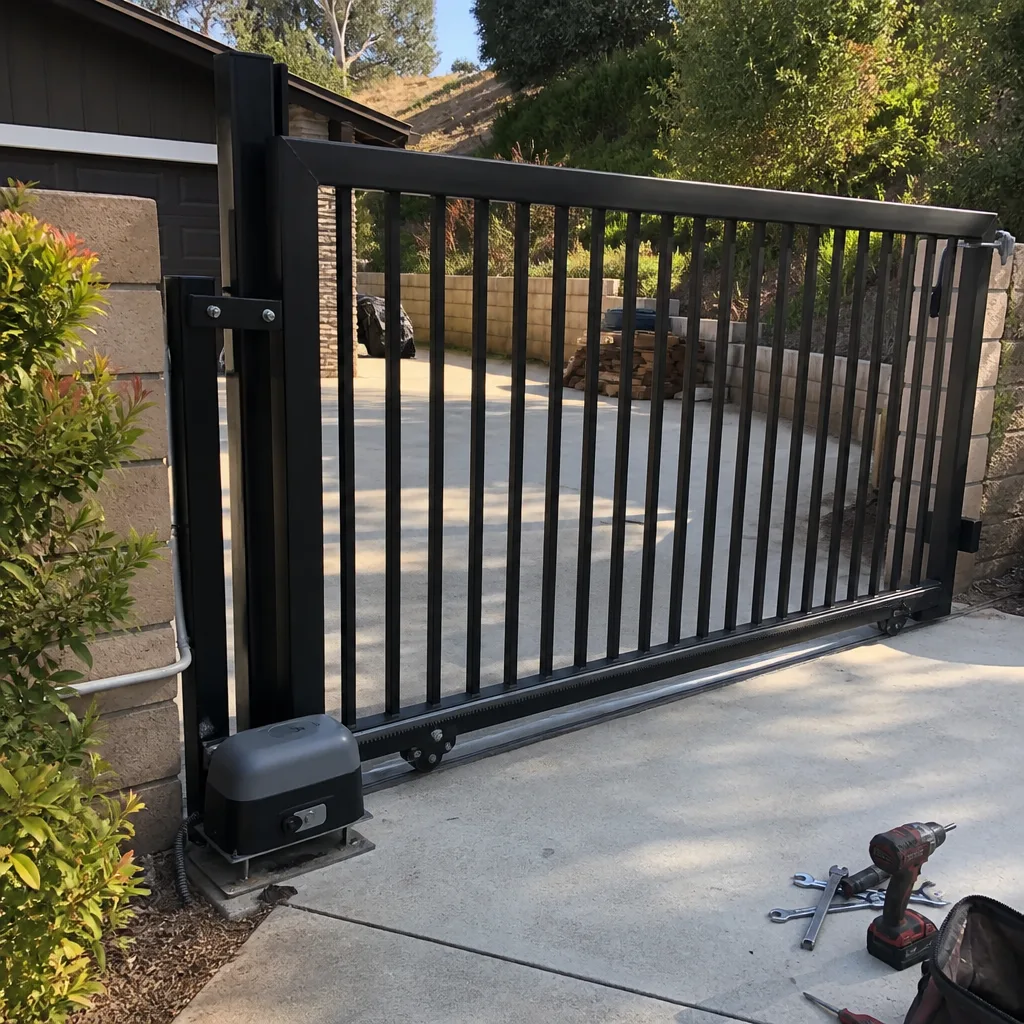 After
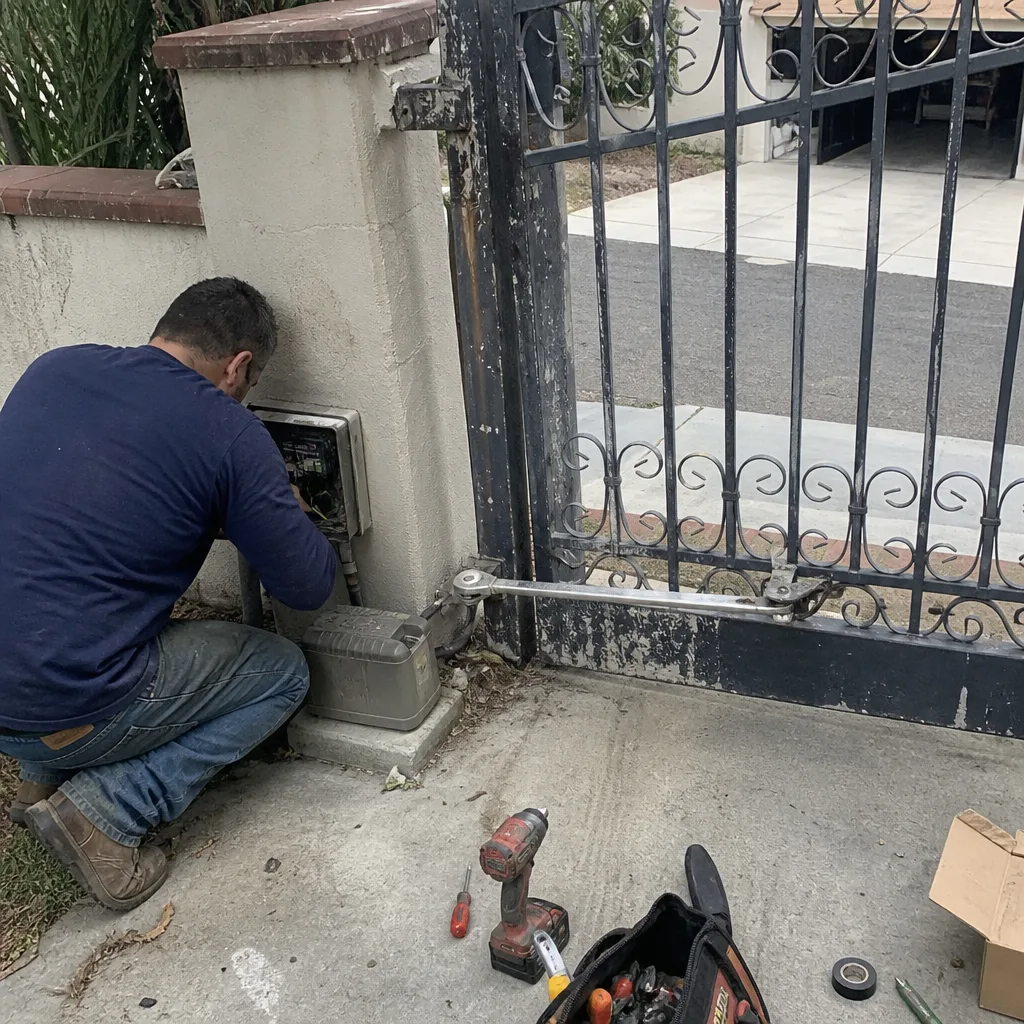 Before
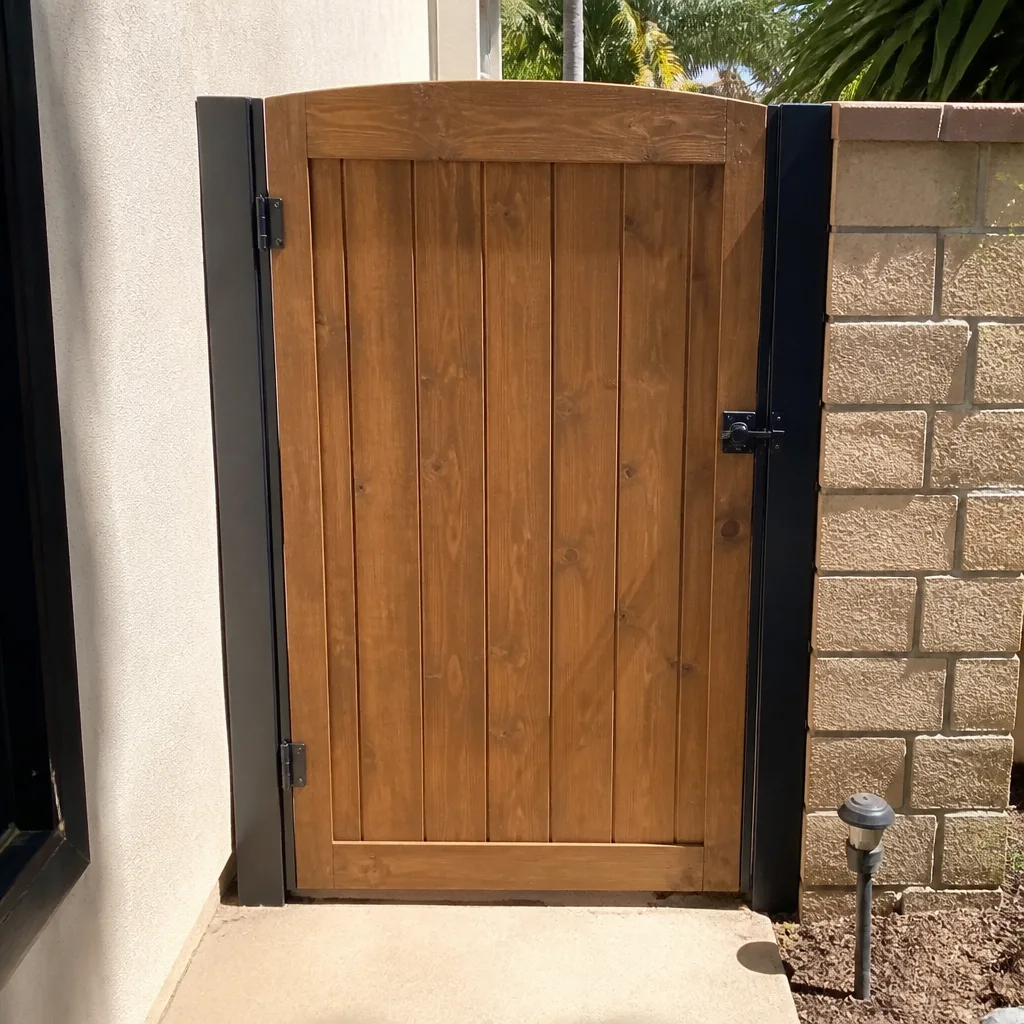 After
 Before
 After